BOOKS BY GREG WITTER
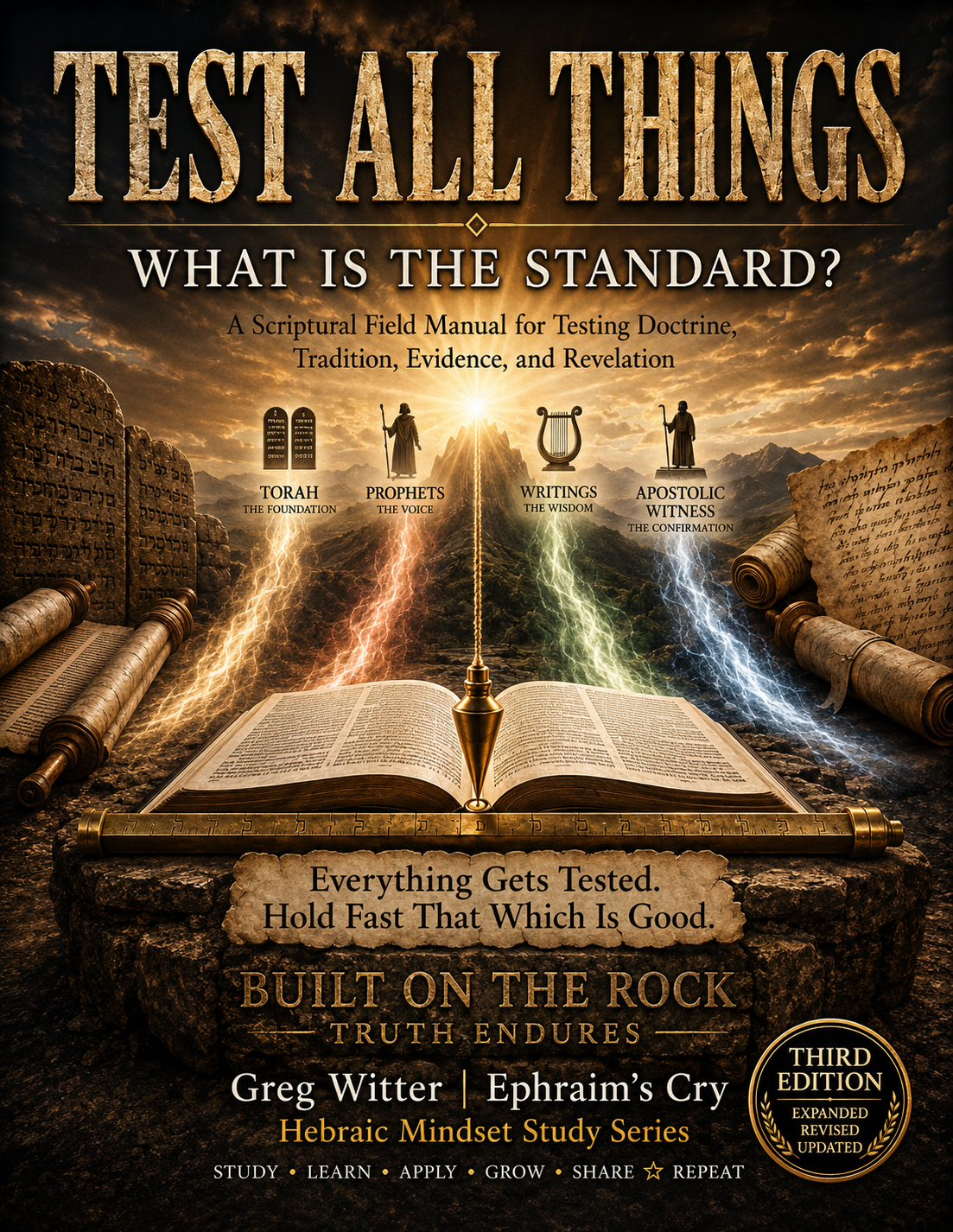
Test All Things
New · Coming Soon
Examine what you believe and the standard by which you test it.
New book — coming soon.
This edition is being prepared for publication. Purchase details will be added when it is ready.
Browse currently available books ↗Check the bookstore listing for the edition and formats currently offered.
About this book
Everything gets tested.
Every doctrine. Every tradition. Every teacher. Every movement. Every calendar. Every interpretation. Every ancient writing. Every manuscript claim. Every historical reconstruction. Every Hebrew word study. Every scholar. Every personal experience. Every claimed revelation. And that includes the things we already believe.
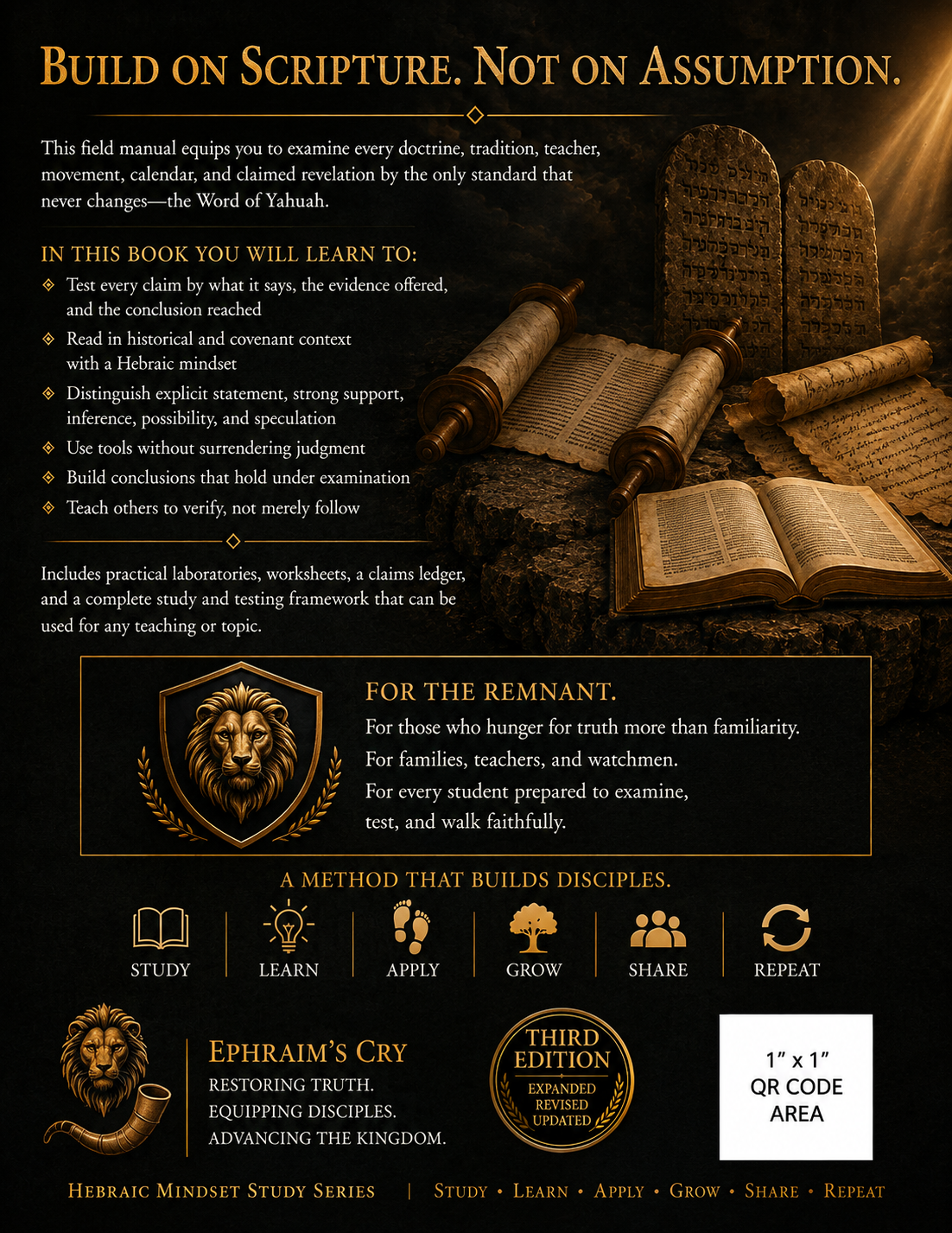
TEST ALL THINGS — WHAT IS THE STANDARD? is a substantial standalone teaching, workbook study guide, and Scriptural field manual designed to equip serious students of Scripture to examine what they are being taught and determine whether the evidence actually establishes the claim.
The central question is simple but unavoidable: If everything is going to be tested, what is the standard?
This book establishes a disciplined Scriptural framework built upon Torah, Prophets, Writings, and Apostolic Witness. Torah establishes the foundation. The Prophets testify, warn, correct, and call back. The Writings preserve wisdom, worship, history, suffering, kingship, and lived covenant testimony. The Apostolic Witness testifies concerning Yahusha and applies the continuing Scriptural witness. The purpose is not to create four competing authorities, but to hear the whole counsel of Elohim without allowing one isolated interpretation to destroy another witness.
From that foundation, the reader learns a complete examination process: TEST THE CLAIM. TEST THE EVIDENCE. TEST THE CONCLUSION.
Rather than merely telling readers what to believe, this field manual teaches them how to identify exactly what is being claimed, determine the burden of proof, examine the passage in context, distinguish description from prescription, evaluate language and hidden assumptions, classify evidence properly, search for contrary evidence, test whether the conclusion actually follows, and state the result no more strongly than the evidence permits.
Every source must remain in its proper place. Tradition may preserve useful information without becoming commandment. Ancient writings may illuminate history without becoming Scripture. Manuscripts may witness to wording without becoming the original autograph. Translations contain interpretive decisions. Masoretic vowel points preserve a received vocalization tradition but are not the original consonantal text. Scholarship, archaeology, historical reconstruction, personal testimony, dreams, visions, and claimed revelation may all contribute information, but none receives permission to override what Yahuah has established in Scripture.
The book therefore examines the proper use and limits of traditions, Enoch, Jasher, Jubilees, the Talmud, Apocrypha, Dead Sea Scrolls, Qumran and Second Temple writings, early Christian sources, manuscripts, translations, Hebrew and Greek studies, Paleo-Hebrew claims, archaeology, scholarship, history, personal experience, and claimed revelation.
A major emphasis of the work is evidence discipline. The reader learns to distinguish explicit statement, necessary conclusion, strong support, reasonable inference, possibility, and speculation or unresolved questions. Possible is not proven. Historical practice is not automatically divine command. A quotation is not canonization. Antiquity is not authority. Popularity is not proof. Expertise is not infallibility. Confidence is not evidence.
This is not a manual for becoming suspicious of everyone. It is a manual for becoming stable enough to hear a claim without immediately surrendering to it or automatically rejecting it. The goal is not endless doubt. The goal is tested faithfulness.
The practical workbook system turns those principles into action through chapter reviews, Examination Labs, a Complete Teaching Examination Worksheet, Four-Witness Matrix, Four A's Source Examination Worksheet, Tradition and Extra-Biblical Source Test, Manuscript and Translation Claim Worksheet, Certainty and Teaching-Language Scale, Common Evidence and Reasoning Errors, glossary, and documentation record.
The final objective is not merely to win arguments. It is to produce mature disciples who can examine claims, correct error, remain honest where evidence is incomplete, hold fast where truth has been established, obey what Yahuah has commanded, and teach others how to verify rather than merely follow.
Test it. Verify it. Confirm it. Prove it. Then, when it survives honest Scriptural examination: HOLD FAST TO WHAT IS GOOD.
Study. Learn. Apply. Grow. Share. Repeat.
What you can gain
- Establish a Scriptural measuring rod using Torah, Prophets, Writings, and Apostolic Witness.
- Understand why Torah functions as the foundational measuring rod for later claims and interpretations.
- Identify the actual claim and assign a burden of proof proportionate to what is being asserted.
- Read claims in passage, chapter, book, genre, historical setting, and covenant context.
- Distinguish description from prescription, text from interpretation, and evidence from conclusion.
- Test Hebrew and Greek word studies without allowing roots, lexicons, or Paleo-Hebrew imagery to carry doctrine by themselves.
- Evaluate manuscripts, translations, textual variants, consonantal evidence, Masoretic vocalization, and ancient versions in their proper categories.
- Apply the Four A's of source examination: Authorship, Authenticity, Accuracy, and Authority.
Table of contents
From the available manuscript. Contents may change during revision.
View the table of contents
- Chapter 1 — Everything Gets Tested - Starting with Me
- Chapter 2 — Discernment Without Cynicism
- Chapter 3 — The Responsibility of Teacher and Student
- Chapter 4 — What Is Scripture?
- Chapter 5 — Torah - The Foundational Measuring Rod
- Chapter 6 — The Four-Witness Standard
- Chapter 7 — Tradition Under Scripture
- Chapter 8 — Information Is Not Authority
- Chapter 9 — Enoch, Jasher, and Jubilees
- Chapter 10 — Talmud, Apocrypha, Dead Sea Scrolls, and Other Ancient Sources
- Chapter 11 — Test the Claim
- Chapter 12 — Language, Context, and Hidden Assumptions
- Chapter 13 — Manuscripts, Translations, and Vowel Points
- Chapter 14 — Scholarship, History, Experience, and Claimed Revelation
- Chapter 15 — Test the Conclusion
- Chapter 16 — Certainty, Contrary Evidence, and Application
- Chapter 17 — Hold Fast to What Is Good
- Chapter 18 — Study, Learn, Apply, Grow, Share, Repeat
Read a sample chapter
Coming Soon — a selected chapter will be available here to read and review.
A look inside
Coming Soon — selected charts, illustrations, or teaching graphics will offer a closer look inside the book.