BOOKS BY GREG WITTER
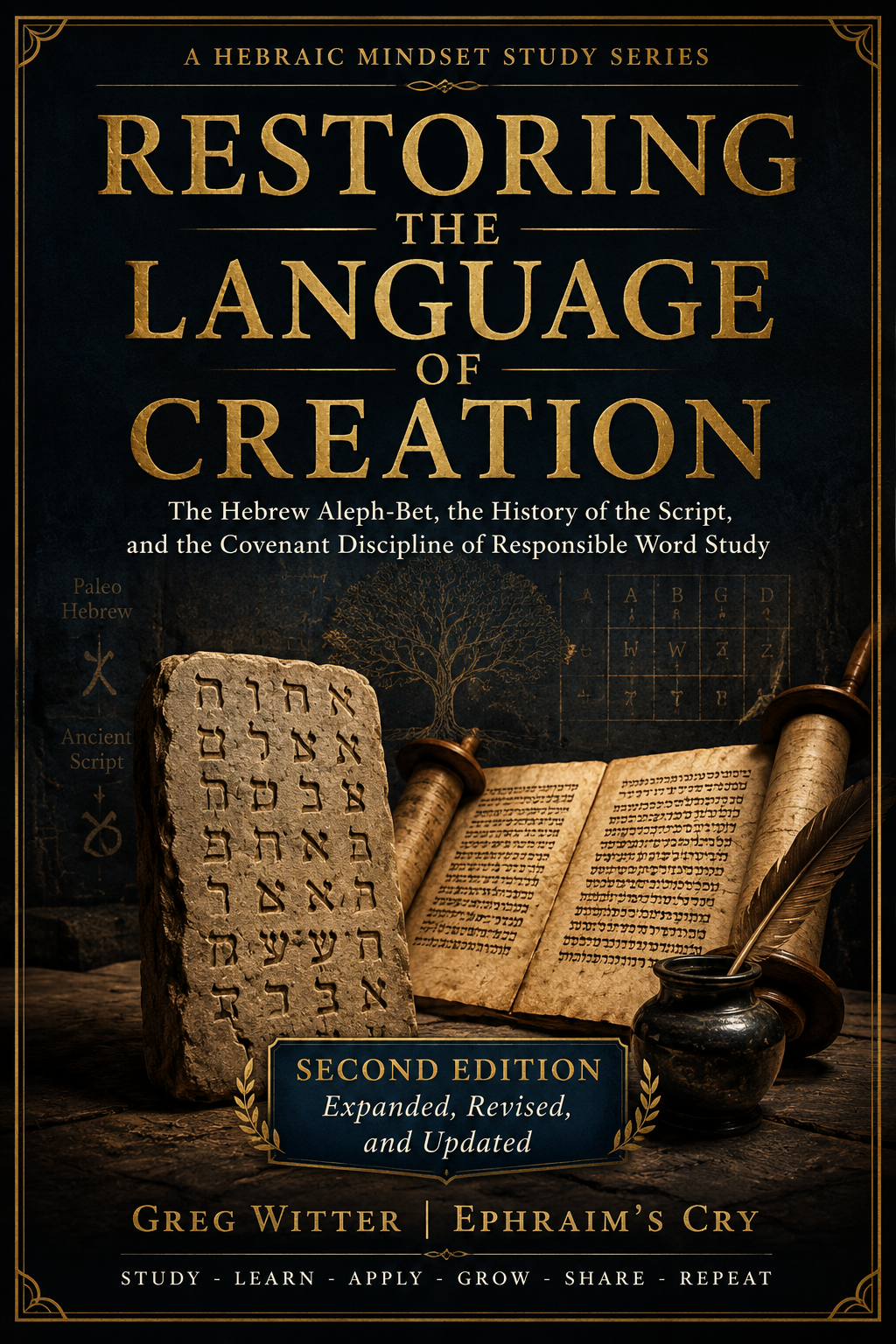
Restoring the Language of Creation
Coming Soon
Explore the language of Scripture and its connection to understanding.
Revised Edition — Coming Soon.
This edition is being prepared for publication. Purchase details will be added when it is ready.
Browse currently available books ↗Check the bookstore listing for the edition and formats currently offered.
About this book
Language matters because words carry testimony. But what happens when the tools meant to help us understand Scripture begin to rule the text instead?
Restoring the Language of Creation, Second Edition — Expanded, Revised, and Updated is a substantial 8.5 × 11 study guide, workbook, and teaching resource for students who want to recover the Hebrew language and the history of the biblical scripts without replacing careful exegesis with speculation. It explores the Hebrew Aleph-Bet, Paleo-Hebrew, square Hebrew, consonantal writing, reading traditions, Masoretic vocalization, word roots, pictographic associations, covenant vocabulary, and responsible word-study method—all beneath the authority of Scripture.
This Second Edition preserves the wonder of the ancient letters while strengthening the evidence discipline behind their use. Greg Witter distinguishes language from script, consonants from supplied vocalization, lexical meaning from letter symbolism, historical evidence from devotional application, and what can be established from what remains possible or unresolved. The result is not less Hebraic. It is a more careful, reproducible, and accountable Hebraic approach.
The book begins by recovering the language without losing the text. Readers learn why Hebrew matters, how the Four Scriptural Witnesses—Torah, Prophets, Writings, and Apostolic Witness—govern doctrine, how Hebrew, Aramaic, and Greek function within the Scriptural record, why simplistic Hebrew-versus-Greek caricatures fail, and how translation and tradition must be examined according to evidence rather than assumption.
From there, the study moves into the history of the scripts: what Paleo-Hebrew is and is not, how early alphabetic writing developed, how Hebrew came to be written in later square forms, how consonantal texts function, how matres lectionis assist reading, and how the Masoretic tradition can be treated as an important witness without confusing later vocalization with the earliest written consonantal form.
At the heart of the book are twenty-two controlled studies—Aleph through Tav. Each letter is examined through its square and Paleo-Hebrew forms, consonantal value, historical association, evidence limits, example words, covenant teaching reflection, Four-Witness connections, and practical exercises. The reader is taught to appreciate ancient pictorial associations without turning them into hidden dictionary definitions or secret messages that override grammar and context.
The covenant-application section then puts the method to work on consequential subjects: the Name of Yahuah, historical pronunciation evidence, Paleo-Hebrew Name meditations, Torah, shalom, shema, emunah, berit, qodesh, ruach, prophetic and devotional use of the letters, teaching the Aleph-Bet in the home and assembly, and restoring biblical language without simply creating another human tradition.
This is a working study guide. It includes a controlled twenty-two-letter reference, a Responsible Hebrew Word-Study Worksheet, sources organized by authority and function, a glossary, and a Claims and Certainty Ledger. Throughout the book, readers learn to label conclusions honestly: explicit, linguistically established, historically supported, reasonable teaching association, devotional reflection, or unresolved.
This book is for serious students of Scripture, families, teachers, watchmen, ministry leaders, study groups, and disciples who want to learn Hebrew responsibly without surrendering judgment to charts, slogans, traditions, scholars, popular teachers, or attractive word pictures.
The objective is not to create an insider class that possesses a secret Hebrew code. It is to form faithful students who can recognize the letters, study words in context, evaluate historical claims, appreciate legitimate symbolism, distinguish evidence from illustration, and return every conclusion to the whole counsel of Scripture.
Keep the wonder. Keep the language. Keep the ancient script. But keep every tool beneath the authority of the Word.
Study. Learn. Apply. Grow. Share. Repeat.
What you can gain
- Understand the difference between Hebrew as a language and Paleo-Hebrew or square Hebrew as scripts used to represent that language.
- Use the Four Scriptural Witnesses—Torah, Prophets, Writings, and Apostolic Witness—as the governing framework for doctrinal conclusions.
- Recognize the securely attested roles of Biblical Hebrew, Biblical Aramaic, and Greek in the surviving Scriptural record.
- Recover Hebraic covenant context without relying on simplistic Hebrew-versus-Greek stereotypes.
- Evaluate translations, traditions, teachers, and language claims according to evidence and burden of proof.
- Trace the development from early alphabetic writing and Paleo-Hebrew forms to later square Hebrew.
- Understand consonantal writing, matres lectionis, vocalization, grammar, and the work of the reader.
- Evaluate the Masoretic tradition as a significant textual and reading witness while keeping consonantal text and later pointing distinct.
Table of contents
From the available manuscript. Contents may change during revision.
View the table of contents
- Why Language Matters - and Why Language Does Not Rule Alone
- The Four Scriptural Witnesses and the Authority of Sources
- Hebrew, Aramaic, and Greek in the Scriptural Record
- Hebraic Context Without the Hebrew-Greek Caricature
- Translation, Tradition, and the Burden of Proof
- What Paleo-Hebrew Is - Language and Script Kept Distinct
- From Early Alphabetic Writing to Square Hebrew
- Consonants, Matres Lectionis, and the Work of the Reader
- The Masoretic Tradition - Witness, Service, and Limits
- Pictographs, Roots, and Responsible Word Study
- Aleph - Strength, Beginning, and the Humility of First Things
- Bet - House, Dwelling, and Covenant Belonging
- Gimel - Movement, Giving, and the Return of Our Deeds
- Dalet - Door, Way, and the Responsibility of Choice
- He - Breath, Attention, and the Call to Behold
- Waw - Hook, Connection, and Faithful Joining
- Zayin - Cutting, Discernment, and the Discipline of the Word
- Het - Boundary, Life, and Set-Apart Belonging
- Tet - What Is Hidden, Tested, and Brought Forth
- Yod - Hand, Work, and Responsible Action
- Kaph - Palm, Receiving, and Surrendered Authority
- Lamed - Goad, Learning, and the Shepherd's Responsibility
- Mem - Water, Life, and the Movement of the Word
- Nun - Seed, Continuity, and Life Through Surrender
- Samekh - Support, Stability, and the One Who Upholds
- Ayin - Eye, Perception, and Disciplined Discernment
- Pe - Mouth, Speech, and Accountable Declaration
- Tsade - Righteousness, Path, and the Pursuit of Justice
- Qoph - Holiness, Horizon, and the Call Beyond Imitation
- Resh - Head, Beginning, and Leadership Under Judgment
- Shin - Tooth, Pressing, and the Discipline of Hearing
- Tav - Mark, Sign, and the Responsibility of Completion
- The Name of Yahuah - Text, Pronunciation, and Reverence
- Covenant Words - Meaning Established by Usage
- Prophetic and Devotional Use of the Letters
- Teaching the Aleph-Bet in the Home and Assembly
- Restoring Language Without Creating Another Tradition
Read a sample chapter
Coming Soon — a selected chapter will be available here to read and review.
A look inside
Coming Soon — selected charts, illustrations, or teaching graphics will offer a closer look inside the book.