BOOKS BY GREG WITTER
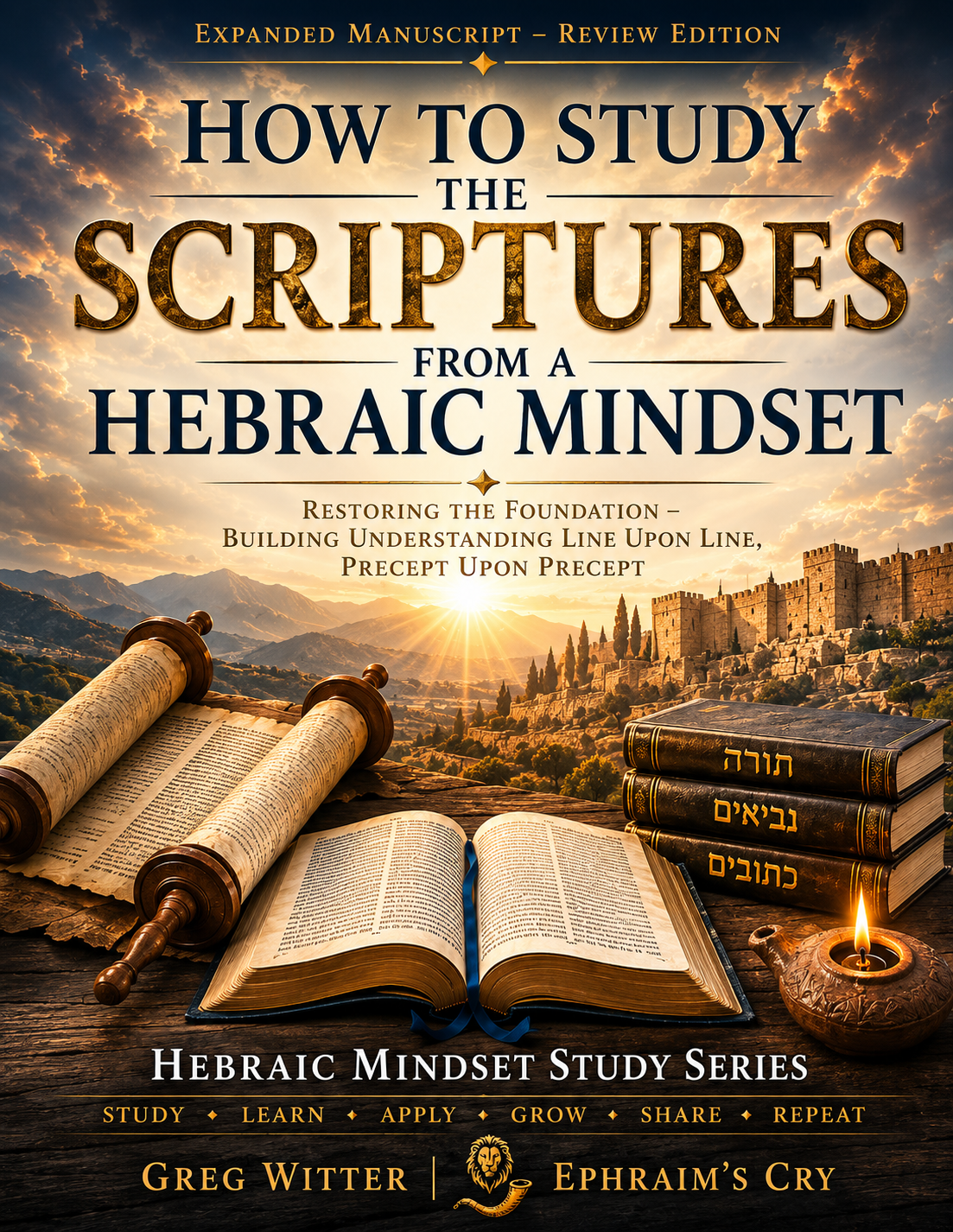
How to Study the Scriptures from a Hebraic Mindset
Revised & Updated
Explore Scripture through a Hebraic mindset, with attention to context and understanding.
Third edition — revised and updated.
Visit the Ephraim’s Cry bookstore ↗Check the bookstore listing for the edition and formats currently offered.
About this book
How do you know whether a teaching is actually established by Scripture - or whether you have simply been handed someone else's conclusion?
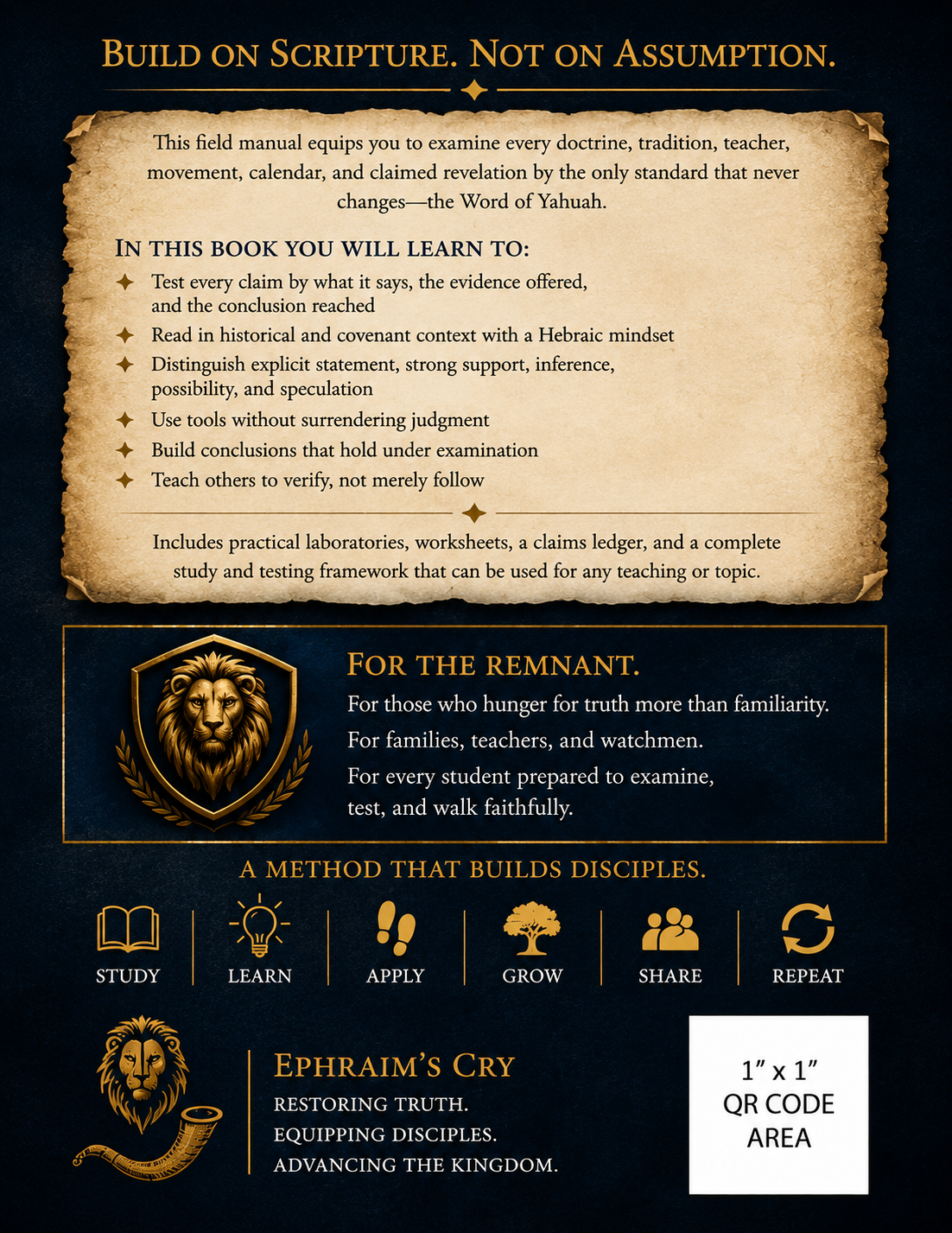
How to Study the Scriptures from a Hebraic Mindset, Third Edition - Expanded, Revised, and Updated is more than a book about Bible study. It is a practical workbook, field manual, and testing system designed to teach you how to open the Scriptures, examine a claim, weigh the evidence, identify assumptions, and reach conclusions that are no stronger - and no weaker - than the evidence permits.
Written from a Hebraic, covenant-centered perspective, this substantially expanded Third Edition restores Scripture to its historical and covenant setting while refusing to make "Hebraic" terminology, tradition, teachers, scholarship, ancient writings, or modern technology a substitute for the text itself. The governing principle is simple: build on Scripture, not on assumption.
Rather than teaching readers merely what to believe, Greg Witter teaches a repeatable method for discovering why a conclusion should be believed. Readers learn to read before concluding; distinguish exegesis from eisegesis; identify author, audience, genre, historical setting, and covenant context; compare Scripture with Scripture responsibly; conduct careful Hebrew and Greek word studies; evaluate translations, manuscripts, Masoretic vocalization, Paleo-Hebrew claims, archaeology, traditions, teachers, personal revelation, and AI-assisted research; and separate the claim, the evidence, the conclusion, and the application.
At the heart of the book is a Four-Witness study framework - Torah, Prophets, Writings, and Apostolic Witness - used to keep the whole Scriptural testimony in conversation. The reader is repeatedly challenged to ask: What does the text explicitly say? What is strongly supported? What is a reasonable inference? What is merely possible? And what remains speculative or unresolved?
This is not passive reading. It is a working study guide. Practical laboratories put the method to work on difficult and frequently disputed subjects, including Yahusha and the Rock, the New Covenant and Torah written on the heart, Enoch/Jasher/Jubilees and the Dead Sea Scrolls, Sacred-Name claims, biblical calendar claims, and Kingdom prophecy and the Greater Exodus.
The expanded workbook section provides a complete Study and Testing Worksheet, glossary, source-evaluation tools, the Four A's of Authorship, Authenticity, Accuracy, and Authority, a Four-Witness Doctrine Worksheet, claims ledger, covenant-analysis worksheet, four complete study pathways, a twelve-week study and teaching plan, study-journal tools, and documentation resources.
This book is for serious students of Scripture, families, teachers, watchmen, ministry leaders, study groups, and newly awakening disciples who are no longer satisfied with "because my pastor said," "because the rabbis say," "because a scholar says," "because an ancient book says," or "because AI says." Every source can be useful. Every teacher can contribute. But every claim still has to be tested.
The objective is not to create followers who depend upon another teacher. It is to form faithful workmen who can read carefully, think clearly, test responsibly, correct themselves when necessary, obey what is established, and teach others how to verify rather than merely follow.
Study. Learn. Apply. Grow. Share. Repeat.
Test all things. Hold fast to what is good.
What you can gain
- Approach Scripture from its Hebraic, historical, communal, and covenant setting without turning "Hebraic" into an automatic proof.
- Read passages in their full context: sentence, paragraph, chapter, book, audience, genre, historical setting, and covenant moment.
- Distinguish observation, interpretation, and application - and recognize exegesis versus eisegesis.
- Use the Four Scriptural Witnesses - Torah, Prophets, Writings, and Apostolic Witness - as a disciplined whole-Scripture testing framework.
- Conduct responsible Hebrew and Greek word studies while avoiding root fallacies, illegitimate totality transfer, and unsupported letter-picture claims.
- Evaluate translations, manuscripts, Masoretic vocalization, Paleo-Hebrew, historical evidence, archaeology, and scholarly sources without surrendering judgment.
- Test teachers, traditions, rabbinic claims, ancient writings, personal testimony, claimed revelation, digital research, and generative AI.
- Apply the Four A's: Authorship, Authenticity, Accuracy, and Authority.
Table of contents
From the available manuscript. Contents may change during revision.
View the table of contents
- The Purpose and Posture of Study
- The Structure and Unity of Scripture
- The Hebraic Mindset as Historical and Covenant Context
- Authority, Interpretation, Tradition, and Experience
- Exegesis and Eisegesis
- Context: Passage, Chapter, Book, Audience, and Genre
- Scripture Interpreting Scripture
- Literary Patterns, Typology, and Prophecy
- Responsible Word Studies
- Translations, Manuscripts, and Historical Evidence
- Testing Teachers, Traditions, and Claimed Revelation
- Test the Claim
- Test the Evidence
- Test the Conclusion and Its Application
- Study with Prayer, Meditation, and Memorization
- Build a Household Culture of Scripture
- Teach Others Without Creating Dependence
- Hold Fast and Continue Growing
Read a sample chapter
Coming Soon — a selected chapter will be available here to read and review.
A look inside
Coming Soon — selected charts, illustrations, or teaching graphics will offer a closer look inside the book.