BOOKS BY GREG WITTER
The Biblical Calendar
Coming Soon
Explore the biblical calendar and the appointed times.
Revised and updated edition — coming soon.
This edition is being prepared for publication. Purchase details will be added when it is ready.
Browse currently available books ↗Check the bookstore listing for the edition and formats currently offered.
About this book
Who determines sacred time - Yahuah's Word and created witnesses, or inherited calendars, religious courts, sectarian systems, and modern assumptions?
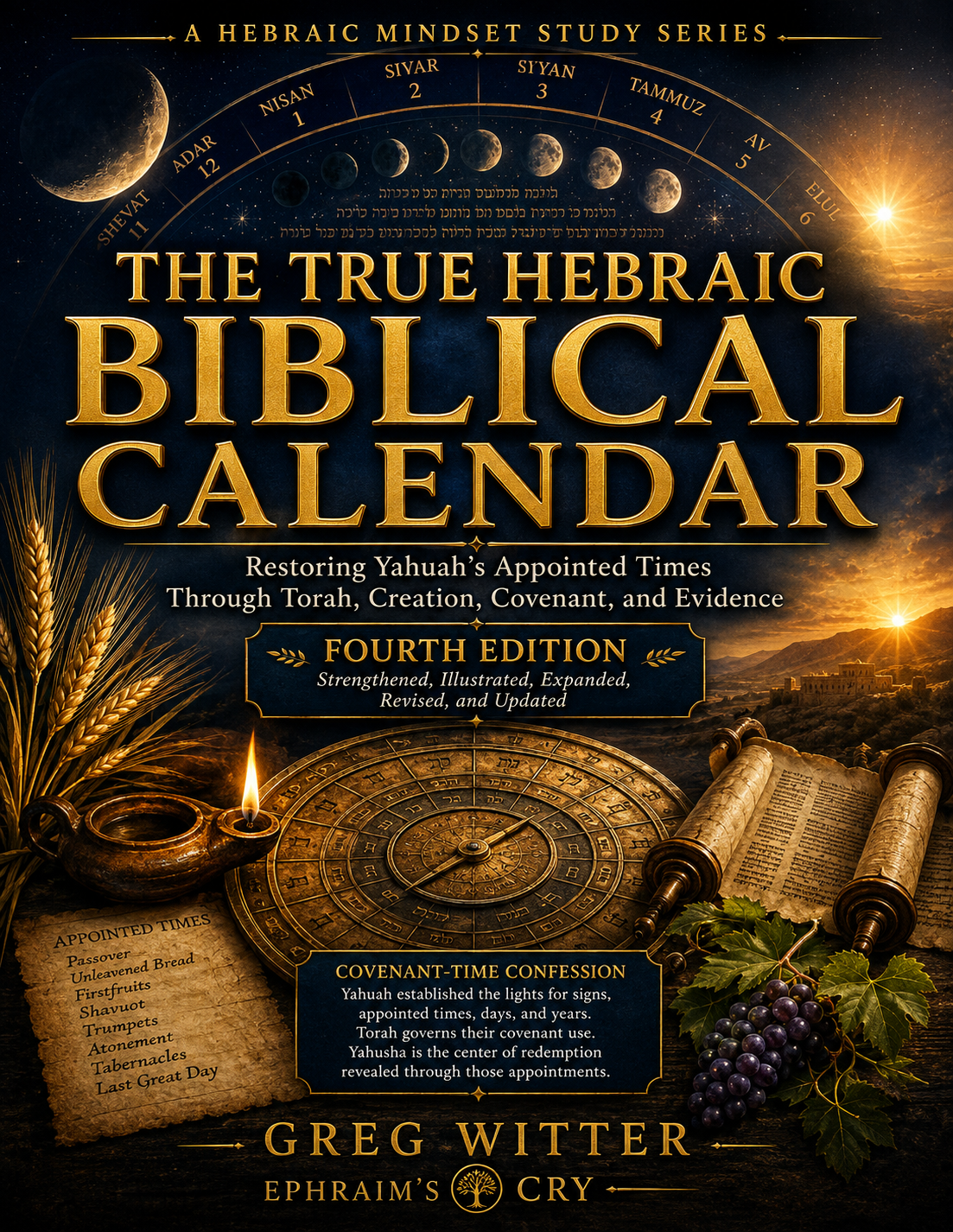
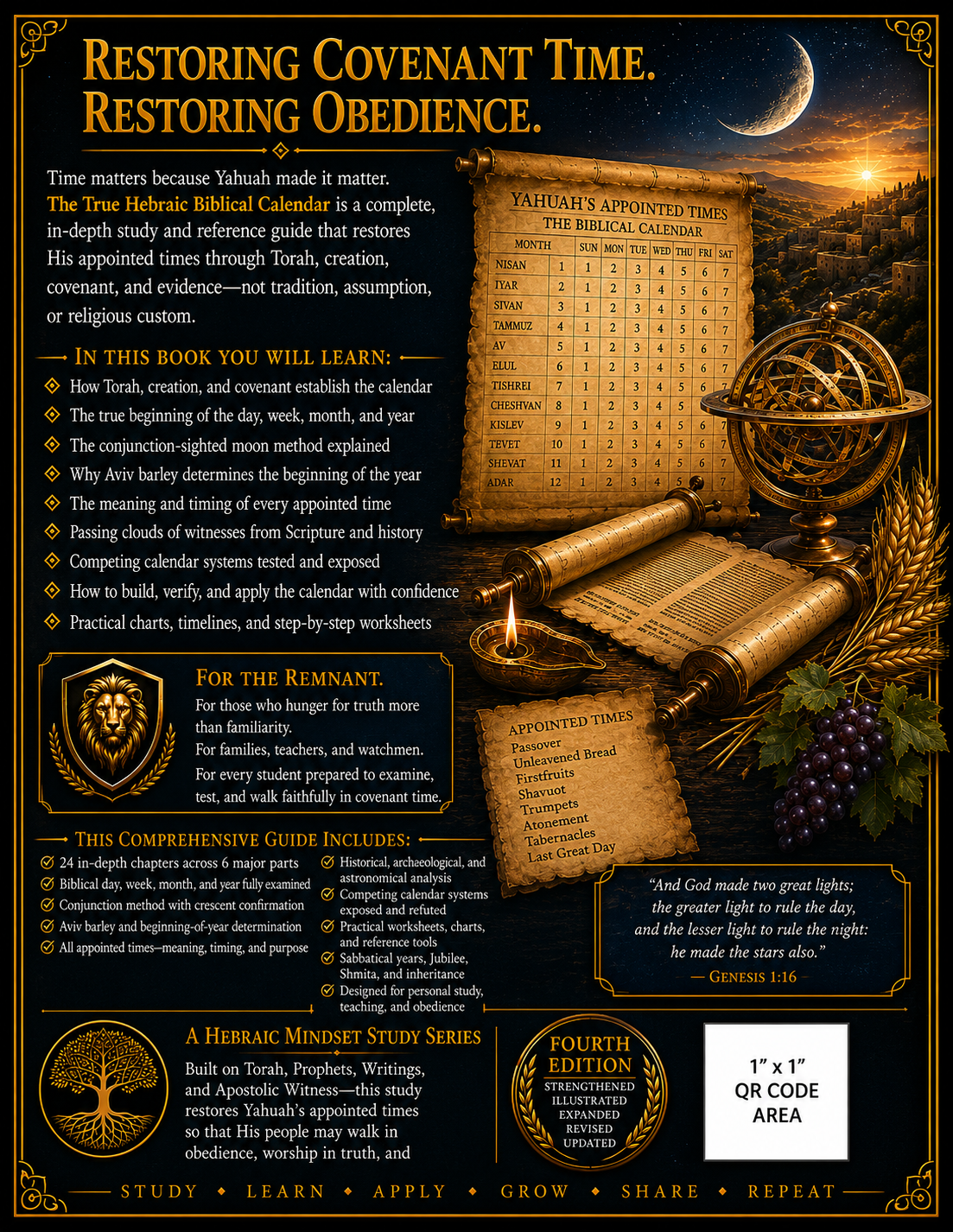
The True Hebraic Biblical Calendar, Fourth Edition - Strengthened, Illustrated, Expanded, Revised, and Updated is a substantial 8.5 x 11 workbook study guide and field manual for restoring Yahuah's appointed times through Torah, creation, covenant, and evidence. It does not merely publish dates. It teaches the reader how the biblical day, week, Sabbath, month, year, and appointed times fit together as one covenant-time system.
Torah remains the governing foundation. The Prophets guard and call back. The Writings preserve the lived testimony of covenant time. The Apostolic Witness applies the established pattern in Messiah. Astronomical calculations, agricultural observations, historical sources, ancient manuscripts, rabbinic traditions, and modern calendar systems are examined as subordinate evidence rather than allowed to become a fifth authority.
This Fourth Edition carefully distinguishes direct command, created sign, historical record, inference, covenant conclusion, and Watchman's warning. That evidence discipline matters because calendar arguments often fail by making an observation sound like a command or by turning an inherited procedure into Torah. The reader is taught to ask not only, 'Is this claim possible?' but, 'What kind of evidence establishes it, and what authority is that evidence permitted to carry?'
The study works from the smallest units outward: the evening-to-evening biblical day; the continuous seven-day week and seventh-day Sabbath; the renewed lunar month; conjunction and the waxing crescent; twenty-nine- and thirty-day months; Aviv, barley, firstfruits, seasonal evidence, and intercalation; and then the complete annual cycle of Passover, Unleavened Bread, Firstfruits, Shavuot, Yom Teruah, Yom Kippur, Sukkot, and the Eighth Day.
Major competing claims are tested directly. The book examines lunar-Sabbath systems, first-visible-crescent authority, rabbinic calendar administration, Christian calendar assumptions, Enoch and Jubilees, Zadokite and Qumran calendar claims, Jasher, equinox-based rules, and other secondary systems. Each is required to show where its controlling rule is actually established and whether it adds to, subtracts from, or overrules Torah.
The governing model argued in this edition uses astronomical conjunction as the objective renewal of the lunar cycle, begins Month Day 1 at the next declared evening boundary after renewal, and treats the waxing crescent as visible confirmation. That administration is defended as a covenant conclusion rather than falsely presented as a word-for-word Torah command. The year is guarded through Aviv and representative agricultural evidence so that Passover and Firstfruits remain in their commanded season.
This is also a working study guide. Chapters include Four-Witness Scripture reading lists, governing claims, evidence boundaries, Watchman's verdicts, covenant-practice applications, glossaries, reflection and review questions with answers, fill-in-the-blank exercises with answer keys, charts, diagrams, decision matrices, and practical calendar-building tools. The goal is not merely to win a calendar argument. It is to form households, students, teachers, and assemblies capable of testing calendar doctrine and walking faithfully in Yahuah's appointed times.
Study. Learn. Apply. Grow. Share. Repeat.
Guard the month. Guard the Sabbath. Guard the appointed times.
What you can gain
- Establish Torah as the governing authority for biblical calendar doctrine.
- Use the Four Witnesses - Torah, Prophets, Writings, and Apostolic Witness - without creating competing authorities.
- Distinguish command, created sign, history, inference, covenant conclusion, and pastoral warning.
- Understand the evening-to-evening biblical day while preserving the distinction between daytime and the complete calendar date.
- Defend the continuous seven-day week and seventh-day Sabbath against lunar-reset claims.
- Examine yareach, chodesh, conjunction, lunar phases, waxing-crescent confirmation, and 29/30-day months.
- Guard Aviv through the land, representative barley evidence, firstfruits order, seasonal corroboration, and transparent intercalation.
- Test equinox rules, sighted-sliver systems, rabbinic procedures, Enoch/Jubilees, Qumran/Zadokite claims, Jasher, and other secondary sources.
Table of contents
From the available manuscript. Contents may change during revision.
View the table of contents
- Chapter 1 — Why the Biblical Calendar Matters
- Chapter 2 — Torah as the Calendar Foundation
- Chapter 3 — The Four Witnesses and the Whole Counsel of Scripture
- Chapter 4 — The Four A's: Authorship, Authenticity, Accuracy, and Authority
- Chapter 5 — Commands, Created Signs, Historical Practices, and Inferences
- Chapter 6 — Testing Rabbinic, Christian, Enochian, Zadokite, and Other Calendar Systems
- Chapter 7 — The Biblical Day
- Chapter 8 — Evening, Sunset, Twilight, and Nightfall
- Chapter 9 — Daylight and Night: Two Portions Within One Biblical Day
- Chapter 10 — The Watches and the Morning and Evening Offerings
- Chapter 11 — The Biblical Week
- Chapter 12 — The Continuous Seven-Day Cycle
- Chapter 13 — The Sabbath as Covenant Sign
- Chapter 14 — Why the Weekly Sabbath Does Not Reset With the Moon
- Chapter 15 — Answering the Major Lunar-Sabbath Arguments
- Chapter 16 — Yareach and Chodesh: Moon and Renewed Month
- Chapter 17 — The Complete Lunar Cycle
- Chapter 18 — Conjunction: Astronomical Renewal and Its Proper Evidentiary Limits
- Chapter 19 — The Last Waning Crescent and the Dark Transition
- Chapter 20 — How Did David Know Tomorrow Was the Chodesh?
- Chapter 21 — The Waxing Crescent as Confirmation
- Chapter 22 — The Sighted-Sliver Deception: Tradition Made Authority
- Chapter 23 — Twenty-Nine- and Thirty-Day Months
- Chapter 24 — Trumpets, New-Month Observances, and Advance Preparation
- Chapter 25 — Testing the Month From Beginning, Middle, and End
- Chapter 26 — Guard the Month of Aviv
- Chapter 27 — What Aviv Actually Means
- Chapter 28 — Birds, Blossoms, Weather, and Other Seasonal Indicators
- Chapter 29 — Mazzaroth: Written in the Heavens, Governed by Torah
- Chapter 30 — Barley, the Land, and the Beginning of the Year
- Chapter 31 — Firstfruits and the Prohibition on New Grain
- Chapter 32 — Intercalation: When a Thirteenth Month Is Necessary
- Chapter 33 — Equinoxes, Seasons, and Calculations
- Chapter 34 — Why the First Month Sometimes Falls in March and Sometimes in April
- Chapter 35 — Secondary Calendar Sources Cannot Govern Torah
- Chapter 36 — Enoch and Jubilees: Ancient Does Not Mean Authoritative
- Chapter 37 — Zadokite and Qumran Calendars: Sectarian Evidence, Not Covenant Law
- Chapter 38 — Jasher: A Biblical Reference Is Not a Blank Check
- Chapter 39 — Do Not Add and Do Not Take Away: The Covenant Verdict
- Chapter 40 — Holy Convocation, High Day, Sabbath, and Sabbath-Rest
- Chapter 41 — Passover: The Fourteenth Day of the First Month
- Chapter 42 — Unleavened Bread: Seven Days of Removal and Remembrance
- Chapter 43 — Firstfruits and the Day After the Sabbath
- Chapter 44 — Counting Seven Complete Sabbaths to Shavuot
- Chapter 45 — Yom Teruah: The Day of Awakening and Alarm
- Chapter 46 — Yom Kippur: Affliction, Covering, and Cleansing
- Chapter 47 — Sukkot: Ingathering, Dwelling, Rejoicing, and the Kingdom
- Chapter 48 — The Eighth Day: Beyond the Millennium Into Eternity Future
- Chapter 49 — How Calendar Error Moves Yahuah's Appointments
- Chapter 50 — The Final Week Must Be Read Through Torah
- Chapter 51 — The Entry Into Jerusalem and the Temple
- Chapter 52 — The Last Supper and the Passover Question
- Chapter 53 — Arrest, Trial, Crucifixion, and Burial
- Chapter 54 — Three Days and Three Nights
- Chapter 55 — The Sabbath and the Sealed Tomb
- Chapter 56 — Resurrection Timing: What the Text Says and What We Infer
- Chapter 57 — Firstfruits and the Risen Messiah
- Chapter 58 — Comparing the Major Final-Week Chronology Models
- Chapter 59 — What the Final-Week Evidence Establishes—and What It Does Not
- Chapter 60 — The Sabbatical Year: The Land Rests Under Yahuah
- Chapter 61 — Release of Debt, Servitude, and Economic Power
- Chapter 62 — The Jubilee: Liberty and Restored Inheritance
- Chapter 63 — What Can—and Cannot—Be Administered Today
- Chapter 64 — Building the Calendar Month by Month
- Chapter 65 — Household and Assembly Practice
- Chapter 66 — Weather, Geography, Time Zones, and Difficult Locations
- Chapter 67 — What to Do When the Evidence Is Uncertain
- Chapter 68 — Testing Traditions Without Condemning People
- Chapter 69 — Final Charge: Return to Yahuah's Appointed Times
Read a sample chapter
Coming Soon — a selected chapter will be available here to read and review.
A look inside
Coming Soon — selected charts, illustrations, or teaching graphics will offer a closer look inside the book.